A first impression is made within the first seven seconds of meeting someone. Teachers have it worse. Reputations proceed them and others’ impressions are often discussed. Parents may think they know their child’s teacher even before the first day. How do we counterbalance the myths of us?
I write.
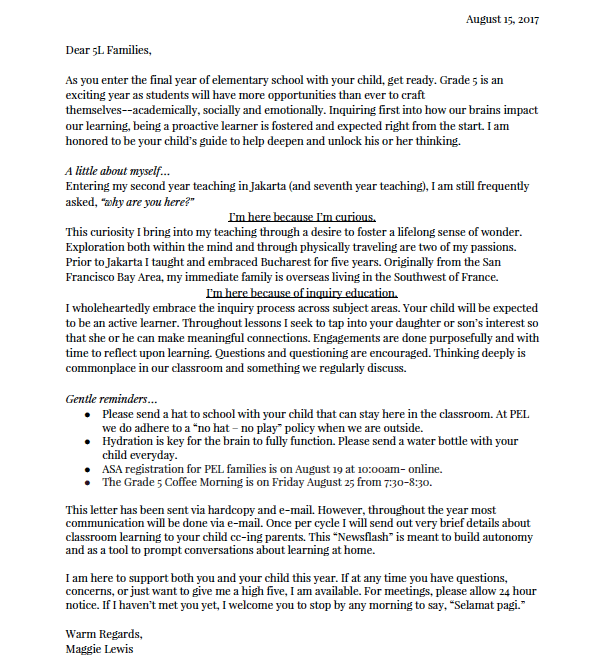
In creating my “First Day of School Letter” I sought something above staleness and overly chipper. Beyond a mere introduction, I wanted parents understanding my teaching philosophy. To begin I asked myself:
Why am I here? Why do I teach? What drives me to do what I do?
Going through the process brought inner tension as I didn’t know what to exclude –everything seemed important. How could parents resist loving me if they only knew___?! Eventually I decided upon two overarching themes–curiosity and inquiry education. By modeling my own vulnerability and faith in the school, I sought to subliminally encourage them to do the same. Result? Parents were open and receptive in us being a team throughout the year. One family, who had little faith in the school, cited the letter as a reason for thinking this year might be different.
Revisiting the letter a year later, I have made little tweaks and added gentle reminders. While the school year has yet to begin, I can only hope the seven seconds it takes families to read the letter will lead to a positive start.
Parents are seen as an essential pillar in their child’s educational success. The classic phrases of “my door is always open” and “we’re a team” are in the Back to School presentation; where for the most part they stay safely tucked away until there is an issue. That may be unfair. For some teachers the painstakingly long newsletter lets parents know about the week’s events and suggests ways they may get involved. What does that look like in the upper grades where student autonomy should be on the rise? How can parents continue the conversation about school beyond “What did you do today?” with their upper elementary child?
I’ve definitely been the teacher who sent home the weekly newsletter and I found that parents didn’t respond and/or there didn’t appear to be any impact on student learning. This year I’ve made my communication more bite size so that parents and students can engage without it being a painstakingly slow read and/or conversation.
BITE SIZE AND NUTRITIOUS
I found that in leading parents to having meaningful conversations about school, I needed to scaffold conversations.
1. Newsflash
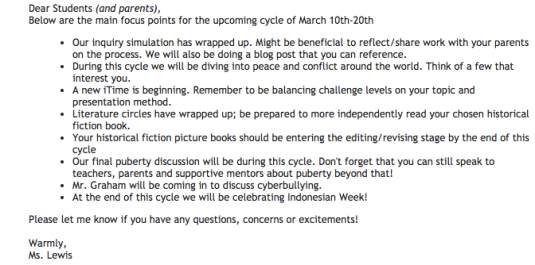
Rather than sending out a weekly newsletter, I send out cyclical ( due to our schedule) notes to students and then cc parents into the e-mail. By sending it out to my fifth grade students, I consciously develop autonomy and give parents a tool to prompt conversations.
Typical Newsflash sent to both parents and students where reminders are woven between curriculum points.
2. Communication Prompts
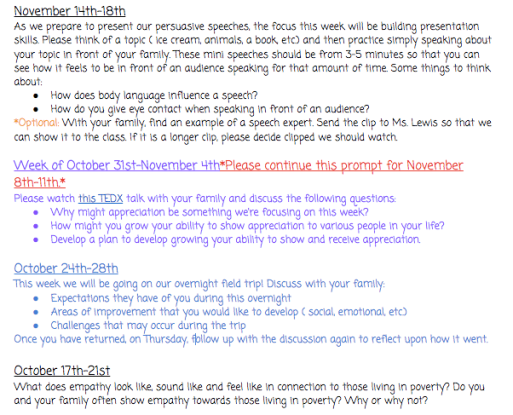
My school has moved away from traditional homework. That being said, most parents are wanting some way to engage with their child about school. Consequently each week I’ll put up a new communication prompt that either relates to learning in some way–either directly as an academic prompt or more indirectly as a social/emotional prompt. These communication prompts often don’t require anything written down;hence, accountability is with students having to discuss the prompts on Fridays during a class meeting. I share these communication prompts on a running GoogleDoc that both parents and students have access to. Upon reflection, linking the document into the Newsflash notes would further promote accountability.
For communication prompts, some videos are hyperlinked so that students and parents have a starting point for dicussions.
3. Test Follow Up Questions
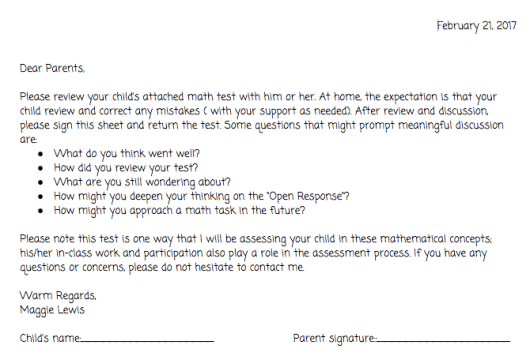
Sending home math tests is a point of contention as some parents don’t see them or they just look for the number of correct questions. By providing a short letter and question prompts, parents are set up to have a higher success rate in discussing the test with their child.
After reflection, the student will return the test with this half sheet note. Each time I get a 100% return rate; hence allowing me to use tests for further instruction.
Well, here I am dear readers. Blog post 1. Who knows how you have stumbled upon this blog. Perhaps similarly to me, there is something that drives you to see the world in a slightly different way; seeing beauty and having curiosity in how the world continues. I am schizophrenic embarking on this journey; having to trust that this blog will evolve and not wanting to somehow mess it all up. With that, I can promise it as a dedication to the beauty in sensing wonder about the world.
Elizabeth Gilbert speaks of this creative challenge in her book Big Magic. A conversation really about the hangups we all have to live an authentic life in taking time to imagine creative possibilities.
Gilbert writes- “The essential ingredients for creativity remain exactly the same for everybody: courage, enchantment, permission, persistence, trust-and those elements are universally accessible. Which does not mean that creative living is always easy, it merely means that creative living is possible.”
With that I wonder about the connection between her essential ingredients for creativity and the permission we give ourselves to recognise the development of these elements. As a teacher, I wonder how often I have told my students “…and don’t forget be creative!” How daunting; especially in that some antonyms of creative are inept, unfruitful, and ungifted. It is no surprise living a creative life is daunting. In a world where children are more than ever expected to be creative how are we, as teachers or really as a society, fostering the essential ingredients Gilbert mentions? How are we pushing them to persevere and seek living a creative living?
Teaching with an inquiry based curriculum I find that I continually push my students to deepen their thinking. One anchor in my classroom is the poster I created (featured below). Often encouraging students to the bottom part of the iceberg; I find myself now wondering if more needs to be done to explicitly bring the essential creative ingredients alive in the classroom.



 Wondering for Wisdom