Where’s Your Crown At?

When I tell some people I’m a teacher, I know what they are thinking–cue the chalkboard, long skirt, and the “oh that’s nice.” Matched with the misconception that I’m a saint, is the notion that I am a queen in a classroom where children follow me around like little birds; perhaps daring to ask me something along the lines of,“Where’s your crown at?” Similar to the 2001 classic, research has led me push the anxiety aside that comes from questioning why I choose not to wear a crown and consider where in fact is my head  about it all?! Across my teaching career, I have worked within schools where teacher collaboration is deemed critical, but I beg to argue that in fact a school’s ecology is intertwined with a teacher’s ability to think and teach fluidly. 

What’s the environment got to do with it?

Take a minute to imagine twins. Now, place those twins in the same grade with two different teachers. Hattie describes such a set of twins being positively influenced by factors beyond teachers themselves alongside different forms of support, such as their interactions with other adults in the classroom (Hattie, 2013). While having additional support in the classroom isn’t news, what stands out is the significance in that “some of the most powerful effects on achievement could stem from the continuity of quality instruction within teaching teams and across years (Hattie, 2013).” Meaning that a queen or king’s reign does influence students, but the key here is opening up the possibility for more quality individualized instruction within each year. Significantly, his findings indicate that student learning is largely impacted by the way in which teachers purposefully seek colleagues to consistently integrate themselves in the learning environment. 

Openings and Opportunities- make it easy.

Create openings. Physical openings in the form of an open classroom create opportunities where connections can be built in the everyday flow between students and teachers. An open classroom not only takes the teacher out of isolation but increases informal communication amongst teachers (Alterator & Deed, 2013). Sounds like an easy enough way to help us all put egos aside; but we all know those teachers–the ones who seem to have the super glue around their crowns.  While change management will need to be another blog post, let this highlight from Alterator’s 2013 case study on an open learning space serves as a third point. 

Now there’s the constant questioning and how can we change what we’re doing to meet the needs of the kids. This has fostered the teamwork. It’s not just about photocopy costs. Now it is about learning. That in itself fosters teamwork. If the focus is on the learning and on the kids then everyone is coming from the same viewpoint, (Teacher D)

(Alterator p.324,2013)

A veteran teacher, Teacher D points to a learning environment which naturally lends itself to student learning being at the center of a clinical practice model. Upon reflection, my best teaching has been through moments where I was challenged to consider best practice for different learners. With open space learning environments, opportunities for connections amongst teachers and students have possibilities to flourish. If we’re wanting to personalize and give students autonomy then we need to support them with how teachers interact with them and the space students are in (Prakash, 2006). This calls for us as teachers to reevaluate the learning environments, to open up possibilities for student/teacher connections. And there we have it. The research has been laid now and so now we’re all living happily ever after in our evidence-based practice teaching amongst our colleagues in an open space. 

Except we’re not. How can this be?

For me, the response is vulnerability. Theory is not enough. Consider this: 

Brown explains this further in her TEDTalk The Power of Vulnerability. Teaching with adults in an open space exposes your imperfect teaching qualities. With that, we have a choice to lean into the discomfort –sparking courageous conversations for ultimate benefit to create lifelong learners. Knowing about the impact and power of multiple teachers within an open learning space means nothing if we are not having courage to be vulnerable. That’s tough. How can we hold each other accountable? What will this look like for you? 

Obligations-make it stick.

Ok, so let’s just all put our egos aside and get on with it. While this seems simple enough, the false dichotomy is in fact teachers being egotistical or collaborative. If we want a classroom environment that is grounded in consciously providing for the students’ needs and promoting lifelong learning (Graham, 2015), I argue we need support. Further blog posts will explore Harry’s Shier’s (1999) work on the need for openings, opportunities, and obligations as a pathway for participation.

Take Time to Wonder

-Are you doing what’s best for supporting student needs on an individualized level?

-So what? How will you create openings and opportunities on your team?

-Why is it easy or challenging for you to lean into the space “imperfect teaching?”

References

Alterator, S., & Deed, C. (2013). Teacher adaptation to open learning spaces. Issues in Educational Research, 23(3), 315–330.

Brown, B. (2010). The power of vulnerability. 

Graham, L., Berman, J. & Bellert, A. (2015). Sustainable learning: Inclusive practices for 21st century classrooms. Melbourne, Victoria: Cambridge University Press. 

Hattie, J. & Anderman,E. (2012). International Guide to Student Achievement, Routledge, 

Prakash, N. [Victoria State Government, Education and Training]. (2006, February 20). Interview with Prakash Nair [Transcript]. Retrieved from: http://www.education.vic.gov.au/Documents/school/principals/infrastructure/inttranscnair06.pdfWilliams, M. (2013). Open plan classrooms. The Contemporary Teacher: A blog providing reflections and resources to support Contemporary Learning, 13 April. http://thecontemporaryteacher.global2.vic.edu.au/2013/04/13/open-plan-classrooms/comment-page-1/
For a Minute There, I Found Myself

This blog was first created to pause. In the teaching world, life goes by the school year season with each day speeding by until suddenly you’re in front of a whole new set of children feeling as if you’ve actually never taught a day in your life. Even writing that makes me feel anxious ( I know what I’m doing…right?!).

Where have I been? What have I been doing?

Well, to all you nonreaders out there, the past few years I have been mixing my seasons. Taking a year off teaching to be with our new daughter, beginning and then completing my Masters in Education-in Evidence Based Practice through the University of Melbourne, getting married, back in the classroom, COVID, taking time off again to be with our son, and now back in the classroom again. All of that in one sentence? Yes. All of that in 3 years? Yes. Through all of those experiences I have been pausing and processing in other ways. Now, I’m ready to do so again here.

A spin-off the classic Radiohead song, Karma Police, through those experiences, I found myself and yet the importance to question and reflect is still there. This blog will continue to be a place where ideas are shared from a place of wondering rather than perfection.

So what? Now what?

“Being an inquiry teacher means more than being able to design tasks within a cycle of inquiry or inviting students to ask and pursue problems and questions. Inquiry comes from a deeper commitment to reflective, process-oriented learning. The inquirer (both teacher and learner) sees themselves and their learning as a ‘work in progress.’ They are driven by the desire not to simply accumulate or conquer a body of knowledge but to make meaning of the ever-changing knowledge landscape of which we are part. This includes acquiring knowledge, but it is understanding that is the ultimate quest.”

-Kath Murdoch The Power of Inquiry

Why Reflect?

Awareness does not just happen by accident. In my personal life I find myself constantly reflecting about interactions, grappling with new knowledge and seeking constant growth.

During the previous school year my partner and I were in a long distance relationship. Between work, time difference and general life happenings, we found it challenging to share the small moments. Consequently, we began to write personal reflections in a memory book. By writing one line a day, we found that we became closer and could empathize more with each other. I loved being able to look back on what we did a week ago, a month ago and ,pretty soon, a year ago.

My personal experience with daily quick reflection led me to consider incorporating more purposeful and consistent reflection in my class. At times I find that assumptions are made that students can meaningfully reflect upon their personal and academic learning to grow; often that is not the case.

How to Reflect?

*Please note that these ‘levels’ need to be fluid.*

‘Tip of iceberg’ Level 1: Group and Personal Connections

Each day we create our own class ‘line of the day’–a synthesis of high, lows and neutral that students share in a class discussion. Students are encouraged to write personal lines on the calendar cards as well. When leaving for the day, students use reflection prompts, created by Kath Murdock,to share with me on their way out the door. Click here to download the document I revamped based upon Kath’s work. 

This slideshow requires JavaScript.

‘Water level’-Level 2: Class actions

Leading students to the next reflection level takes trust as students have to be more vulnerable. Each week as a class we think about what the goal will be, why we’re doing it and how we’ll achieve it. Throughout the week students are encouraged to add onto the goal to make it more of a graffiti board. It is most effective with the goal being right by the daily schedule; leading to constant reference and life!

‘Diving deep’-Level 3: Individual action 

If we are really pushing dispositional teaching it will be coming through in level 3. This is really the “so what?” part of reflecting. Through action students, and we as people, are continuing to develop and grow. Without this individual action component, why even reflect? At this level, we consider “so what, why does this matter?” and  “now what, with the information you have, are you doing to do about it?”) For my students this action component is critical. We are currently goal setting by zooming into one thing that all of our goals will come out of –one anchoring word. In an upcoming blog  post, I’ll speak to reasons behind the ‘anchor word’ goal setting based upon self-awareness.

With the reflections my students make, I am learning ways to support them with where they are–in a multitude of ways.

How do you make reflecting a daily practice?

Starting Seven

A first impression is made within the first seven seconds of meeting someone. Teachers have it worse. Reputations proceed them and others’ impressions are often discussed. Parents may think they know their child’s teacher even before the first day. How do we counterbalance the myths of us?

I write.

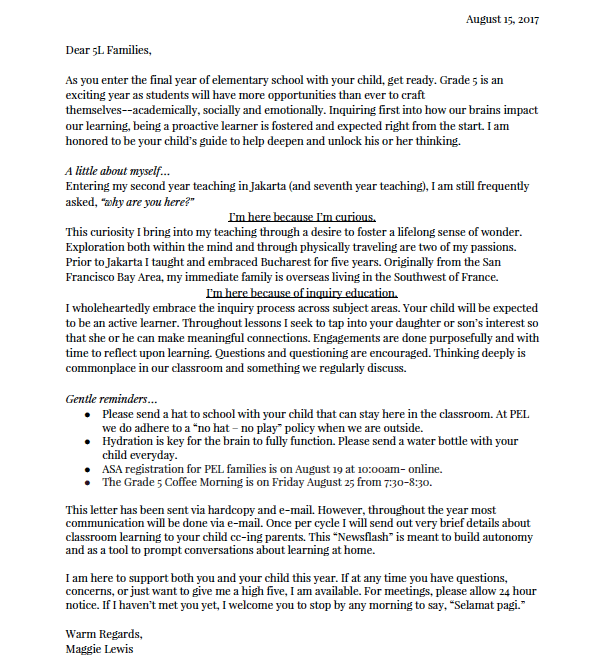
In creating my “First Day of School Letter” I sought something above staleness and overly chipper. Beyond a mere introduction, I wanted parents understanding my teaching philosophy. To begin I asked myself:

Why am I here? Why do I teach? What drives me to do what I do?

Going through the process brought inner tension as I didn’t know what to exclude –everything seemed important. How could parents resist loving me if they only knew___?! Eventually I decided upon two overarching themes–curiosity and inquiry education. By modeling my own vulnerability and faith in the school, I sought to subliminally encourage them to do the same. Result? Parents were open and receptive in us being a team throughout the year. One family, who had little faith in the school, cited the letter as a reason for thinking this year might be different.

Revisiting the letter a year later, I have made little tweaks and added gentle reminders. While the school year has yet to begin, I can only hope the seven seconds it takes families to read the letter will lead to a positive start.


Turning Nothing Into Something

Wait, what!?

A unit changes for whatever reason right before you’re about to teach it. You can feel the panic start to rise with questions swirling: “How can they…”, “What about…” ,“Why would…” Something similar happened at my school, in my grade, on my team, to me! It’s  easy being nostalgic about a unit’s ‘good old days”…even if the re-vamped unit is ultimately better. With not much time to plan before jumping in, I found myself vulnerable and uncomfortable. Even to seasoned teachers, sudden changes immidiately  before starting a new unit might feel unsteady and awkward. For some, it’s easy to get caught in the negativity about the unit; hence, clear teaching is suddenly blocked. So, how am I not getting caught in a web of negativity?

Where to go from here?

I breathed and took a step back to grab onto what I knew. Whether structured, guided, or open,inquiry teaching is about meeting students where they are.

1.No Assumptions

Rather than just assume, a “Chalk Talk” (aka a “Flat Chat”) guided how to plan provocations. Questions asked were based upon the enduring understanding (ie. central idea in PYP language) and criteria (ie. lines of inquiry in PYP language). As I wanted students to deeply engage in the discussion, I also included our class discussion cards directly next to the questions.”

File_000 (1).jpeg

Screen Shot 2017-08-12 at 9.31.52 AM
Prompts created together as a class.

Screen Shot 2017-08-12 at 9.31.41 AM
By creating these together there was more ownership in using them.

2.Seek Insight

Screen Shot 2017-04-11 at 5.57.46 PM.png

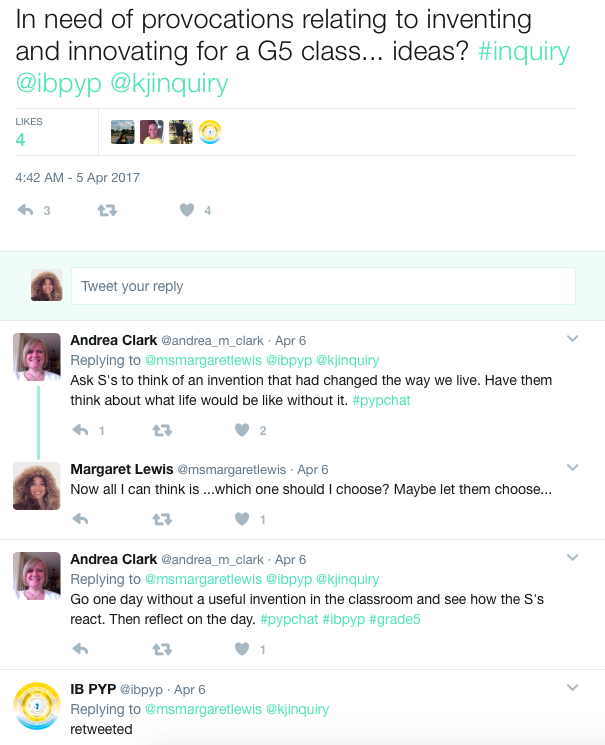
Using Twitter as a platform, I sought to use my vulnerability to benefit my students. By seeking advice via Twitter, I was able to take ideas and then manipulate them to meet my own student needs.

3.Look Beyond

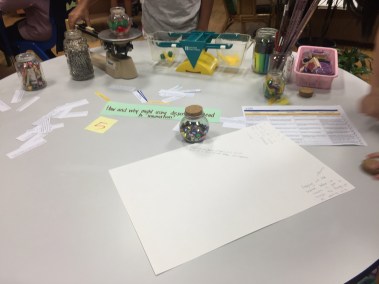
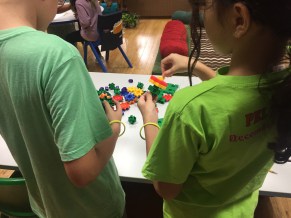
Finding materials is something that can at times seem a challenge for a unit shift. With that, I chose to look beyond our team materials to develop provocations that used materials that weren’t specific rather, bring in materials that might spark thinking. Materials found were from across the school and age range.

File_000.jpeg

             File_003 (2).jpeg 

At the end of the day, being uncomfortable and not knowing exactly how it will all unfold is ok. Move through the uncomfortableness and negativity by responding to student need with purpose.

Enabling: The Powerful Parent

Parents are seen as an essential pillar in their child’s educational success. The classic phrases of “my door is always open” and “we’re a team” are in the Back to School presentation; where for the most part they stay safely tucked away until there is an issue. That may be unfair. For some teachers the painstakingly long newsletter lets parents know about the week’s events and suggests ways they may get involved. What does that look like in the upper grades where student autonomy should be on the rise? How can parents continue the conversation about school beyond “What did you do today?” with their upper elementary child?

I’ve definitely been the teacher who sent home the weekly newsletter and I found that parents didn’t respond and/or there didn’t appear to be any impact on student learning. This year I’ve made my communication more bite size so that parents and students can engage without it being a painstakingly slow read and/or conversation.

BITE SIZE AND NUTRITIOUS

I found that in leading parents to having meaningful conversations about school, I needed to scaffold conversations.

1. Newsflash

Rather than sending out a weekly newsletter, I send out cyclical ( due to our schedule) notes to students and then cc parents into the e-mail. By sending it out to my fifth grade students, I consciously develop autonomy and give parents a tool to prompt conversations.

Screen Shot 2017-03-28 at 12.23.07 PM.png
Typical Newsflash sent to both parents and students where reminders are woven between curriculum points.

2. Communication Prompts

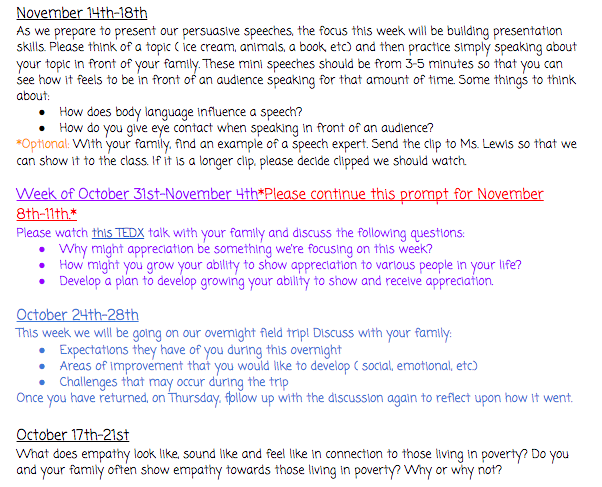
My school has moved away from traditional homework. That being said, most parents are wanting some way to engage with their child about school. Consequently each week I’ll put up a new communication prompt that either relates to learning in some way–either directly as an academic prompt or more indirectly as a social/emotional prompt. These communication prompts often don’t require anything written down;hence, accountability is with students having to discuss the prompts on Fridays during a class meeting. I share these communication prompts on a running GoogleDoc that both parents and students have access to. Upon reflection, linking the document into the Newsflash notes would further promote accountability.

Screen Shot 2017-03-28 at 12.57.33 PM.png
For communication prompts, some videos are hyperlinked so that students and parents have a starting point for dicussions.

3. Test Follow Up Questions

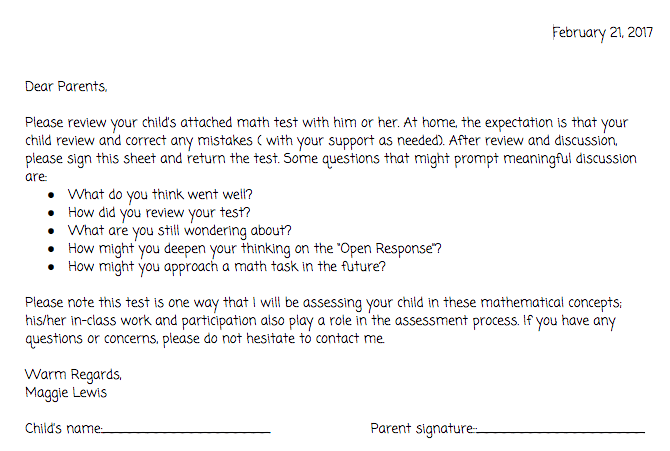
Sending home math tests is a point of contention as some parents don’t see them or they just look for the number of correct questions. By providing a short letter and question prompts, parents are set up to have a higher success rate in discussing the test with their child.

Screen Shot 2017-03-28 at 12.24.16 PM.png
After reflection, the student will return the test with this half sheet note. Each time I get a 100% return rate; hence allowing me to use tests for further instruction.


Imagining Possibilities

Well, here I am dear readers. Blog post 1. Who knows how you have stumbled upon this blog. Perhaps similarly to me, there is something that drives you to see the world in a slightly different way; seeing beauty and having curiosity in how the world continues. I am schizophrenic embarking on this journey; having to trust that this blog will evolve and not wanting to somehow mess it all up. With that, I can promise it as a dedication to the beauty in sensing wonder about the world.

Elizabeth Gilbert speaks of this creative challenge in her book Big Magic . A conversation really about the hangups we all have to live an authentic life in taking time to imagine creative possibilities.

Gilbert writes- “The essential ingredients for creativity remain exactly the same for everybody: courage, enchantment, permission, persistence, trust-and those elements are universally accessible. Which does not mean that creative living is always easy, it merely means that creative living is possible.”

With that I wonder about the connection between her essential ingredients for creativity and the permission we give ourselves to recognise the development of these elements. As a teacher, I wonder how often I have told my students “…and don’t forget be creative!” How daunting; especially in that some antonyms of creative are inept, unfruitful, and ungifted. It is no surprise living a creative life is daunting. In a world where children are more than ever expected to be creative how are we, as teachers or really as a society, fostering the essential ingredients Gilbert mentions? How are we pushing them to persevere and seek living a creative living?

Teaching with an inquiry based curriculum I find that I continually push my students to deepen their thinking. One anchor in my classroom is the poster I created (featured below). Often encouraging students to the bottom part of the iceberg; I find myself now wondering if more needs to be done to explicitly bring the essential creative ingredients alive in the classroom.

What do you wonder?

Screen Shot 2016-10-24 at 4.57.08 PM.png